The story is about the making of Walt Disney’s Mary Poppins, and how Disney wooed author P.L. Travers to allow him to make a film about her “magical” nanny. As expected, Emma Thompson (P.L.Travers) and Tom Hanks (Walt Disney) give absolutely wonderful performances. The author juxtaposes the unbending, surly personality of P.L.Travers’ character, against warm-hearted, passionate and determined Walt Disney, and it works well in the storyline. Of course, while the film’s final scene between Disney and Traver’s is endearing and heart-warming, it is completely embellished. The real story portrays a very unhappy Travers over the final outcome of the film, and it appears Disney and Travers end things on a very sour note.However, the film keeps the moment magical, and it works. Our hearts are lifted, and we (the audience) are contented.
 Saving Mr. Banks manages to weave together two separate
stories: the story of Ginty, an eight-year-old Australian girl and her
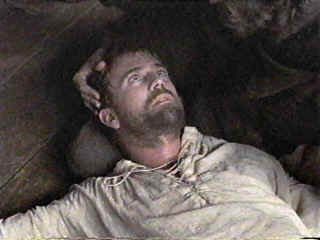
relationship with her father, Travers Goff (Colin Farrell). Ginty and
her father have a unique, close-knit, loving relationship that is
dramatically affected by his love for the bottle. When his life is cut
short, and he dies, Ginty’s life is forever affected. The bulk of the
narrative is Disney’s pursuit of the story, and the things that
transpire once Travers is flown to Los Angeles to meet the writers
(screenwriting and songwriting) who hope to take the Mary Poppins’ stories and adapt them for the screen.
Saving Mr. Banks manages to weave together two separate
stories: the story of Ginty, an eight-year-old Australian girl and her
relationship with her father, Travers Goff (Colin Farrell). Ginty and
her father have a unique, close-knit, loving relationship that is
dramatically affected by his love for the bottle. When his life is cut
short, and he dies, Ginty’s life is forever affected. The bulk of the
narrative is Disney’s pursuit of the story, and the things that
transpire once Travers is flown to Los Angeles to meet the writers
(screenwriting and songwriting) who hope to take the Mary Poppins’ stories and adapt them for the screen.From the time Travers arrives in Los Angeles, she is uncomfortable and unyielding, in fact, the only one who is really able to crack through her hard-hearted shell, is the friendly limo driver (Paul Giamatti) provided by Disney. He touches the heart of Travers; something that Disney is really never able to do. She is taken off-guard, as he gives her the grand tour of L.A. and takes her to Disneyland. Her relationship with the driver is sincere and gives us a sense of “who” Travers “really” is, when she is normally complex, irritable, and very difficult to deal with. Giamatti’s relationship with Travers is endearing and uplifting.
One of the biggest issues with the script, is the continual flashbacks from the present (life in the 60′s) to Ginty’s troubled childhood in Australia. These flashbacks are used to slowly unveil the complexities that surround Travers and her icy personality. Flashbacks are tricky and can often be risky, but somehow, they work in Saving Mr. Banks. Eventually, the audience is made aware of “why” Travers is so protective over her work; it is related to her need to protect her father. Knowing this history gives the audience a greater understanding and appreciation for Travers. We become engaged, and we care about this character. It’s powerful when the audience cares about the protagonist.
 No doubt, Saving Mr. Banks is well-worth seeing. It encapsulates the word, “entertainment,” and makes the heart glad. <3Travers is not easy won, which really adds to the complex scope of
her character. She is cold, indifferent, calloused, and clearly
flawed. Screenwriters Kelly Marcel and Sue Smith did a great job of
jarring the audiences emotions with this character, and Thompson gives a
rave performance.
No doubt, Saving Mr. Banks is well-worth seeing. It encapsulates the word, “entertainment,” and makes the heart glad. <3Travers is not easy won, which really adds to the complex scope of
her character. She is cold, indifferent, calloused, and clearly
flawed. Screenwriters Kelly Marcel and Sue Smith did a great job of
jarring the audiences emotions with this character, and Thompson gives a
rave performance.The film is actually more about struggle than anything else. While we “think” it’s about how Mary Poppins was made, it’s really much more than that. Both Travers and Disney had troubled childhoods. Disney choose fantasy as a way to ease his own past and conquer his demons, where Travers plummeted herself into her books about a magical nanny–a nanny that would simple whisk heartache and care away. Travers looks at the world through hardness and disappointment, and Disney creates a new world–a happy place to shield himself from pain. It’s a compelling comparison.
For those of you who haven’t yet seen Saving Mr. Banks, I highly recommend it. Based on the true story of P.L. Travers, author of the Mary Poppins children’s books, Saving Mr. Banks promises to entertain, prod emotion, and warm the heart.